A new web site was launched yesterday for the Ridi Viharaya, Kurunegala.
It has a Sinhala Unicode version thought not fully implemented.


Showing posts with label Photography. Show all posts
Showing posts with label Photography. Show all posts
2007-12-30
Ridi Viharaya goes online
2007-07-15
Typo?
Typo is an abbreviation used to denote a typographical error or an error in a typeset. But now it's commonly used to define all spelling mistakes. For bloggers like us, it's a common thing, though we try hard not to do such mistakes.
 Photo: AP Photo by John Raoux
Look at these images closely. They were taken when the Endeavour space shuttle was taken to it's launch pad today. Look carefully at the banner. Can you see a difference between the two photos? First one says 'Go Endeavor'. But the space shuttle is named 'Endeavour' after 18th century explorer James Coock's ship HM Bark Endeavour. The mistake was noticed & was corrected as seen in the second photo, where the banner reads 'Go Endeavour'.
So typos can happen even at that level? Please bare with me if I have done any...
So typos can happen even at that level? Please bare with me if I have done any...
2007-07-06
Talents 2007


There were only two days remaining, when I got hold of the news about Talents 2007. I had to make some arrangements in a haste so I can attend the occasion.
During our University life, Talents was a major event where we looked forward to with much enthusiasm. During the period we got prepared for the variety show, the faculty start to overflow with life. Heads bent on books, start to wander around singing, dancing, acting & laughing. It's the time to dream, rather to make creative dreams & make them a reality. It's a welcome break from the tedious work at the faculty, but still managing to find time to run for lectures, tutorials, practicals, ward work, etc..
Committees elected from the students look after various aspects of logistics in this mega event, with help from experienced seniors & the ever so helpful staff members, ranging from the academic to non-academic.
It always brings back memories when I sat in front of the stage, of the time we were in the limelight. Ahh weeks, if not months, of preparations, sleepless nights... After all it lasts only for few moments on stage...
There were only very few I knew among the students. I only can remember them very faintly, even tough they could remember me very well. After all it was a grand show second to none, of it's predecessors...
Keep it up dear sisters & brothers, it's our signature... A unique blend of Arts & Medicine...
Please visit my previous post on Talents 2006
Also visit: Talents
During our University life, Talents was a major event where we looked forward to with much enthusiasm. During the period we got prepared for the variety show, the faculty start to overflow with life. Heads bent on books, start to wander around singing, dancing, acting & laughing. It's the time to dream, rather to make creative dreams & make them a reality. It's a welcome break from the tedious work at the faculty, but still managing to find time to run for lectures, tutorials, practicals, ward work, etc..
Committees elected from the students look after various aspects of logistics in this mega event, with help from experienced seniors & the ever so helpful staff members, ranging from the academic to non-academic.
It always brings back memories when I sat in front of the stage, of the time we were in the limelight. Ahh weeks, if not months, of preparations, sleepless nights... After all it lasts only for few moments on stage...
There were only very few I knew among the students. I only can remember them very faintly, even tough they could remember me very well. After all it was a grand show second to none, of it's predecessors...
Keep it up dear sisters & brothers, it's our signature... A unique blend of Arts & Medicine...
Please visit my previous post on Talents 2006
Also visit: Talents
2007-05-31
Once in a Blue Moon

Well it seems my postings have become so rare lately, that I post 'Once In a Blue Moon'. Well today is a such day, that we are going to have a Blue Moon.
Blue Moon, has nothing to do with it's colour. It only means, a full moon that occurs for the second time in a month. Considering that the average interval between two full moons is about 29.5 days & a month has about 30.5 days, it's a rare occurrence to have two full moons in a month. But it occurs about 41 times in a century or only occurs once in about 32 months.
The term 'Once in a Blue Moon' has been in use in medieval England from old times & one such occasion was in a 'Treatyse of the Buryall of the Masse' by William Barlow, the Bishop of Chichester, in 1528.
But the usage of this phrase had had different meanings during these long years of use,
Blue Moon, has nothing to do with it's colour. It only means, a full moon that occurs for the second time in a month. Considering that the average interval between two full moons is about 29.5 days & a month has about 30.5 days, it's a rare occurrence to have two full moons in a month. But it occurs about 41 times in a century or only occurs once in about 32 months.
The term 'Once in a Blue Moon' has been in use in medieval England from old times & one such occasion was in a 'Treatyse of the Buryall of the Masse' by William Barlow, the Bishop of Chichester, in 1528.
But the usage of this phrase had had different meanings during these long years of use,
- in 16th century: obvious absurdities, where there could be no doubt.
- in 18th century: as equal to 'never'
- in mid 19th century: a fairly infrequent event
There had been times, where the moon really appeared to be blue. This occurs due to light reflected from moon being scattered by dust particles which are about a micron or so in diameter. In these occasions dust particles were ejected to upper atmosphere during large volcano eruptions such as that occurred in 1883 of Krakatoa volcano or large forest fires that occurred in 1953 in western Canada.
But this year Americans have seemed to have celebrated the Blue Moon on 31st of May, 2007. >>> Blue Moon over North America on Thursday. How can that be? How can they have a Blue Moon two month before New Zelander's had one?
For more details go to The Blue Moon of 2007.
It seems the method used for calculating the blue moon astronomically also had not been the one used earlier. This new definition had come into use after it had been mistakenly interpreted by an amateur astronomer in an article in 1946 in Sky & Telescope magazine on Blue Moons (see What's a Blue Moon?). It had then been adopted by various other newspapers, radio & TV shows giving wide publicity to this misinterpretation.
The correct definition had been a complex one, that uses seasons rather than months to calculate the blue moon. The third full moon occurring in a season with 4 full moons had been considered to be the blue moon (Usually a season only had three full moons). But it had not been so simple either.
The year they used was 'tropical year' running from one winter solstice to the next. The seasons were defined using a method which gives seasons of equal duration (which uses dynamical mean Sun or fictitious mean Sun, which are imaginary bodies & this method is not used now to define seasons). Then also they used some rules which are laid down in Gregorian calendar reform in 1582.
To see a list of blue moons according to this old definition visit Blue Moon - four Full Moons in a season. According to this it seems there is no Blue Moon in 2007. Phew... after all I'm not doing blog posts Once in a Blue Moon.
But this year Americans have seemed to have celebrated the Blue Moon on 31st of May, 2007. >>> Blue Moon over North America on Thursday. How can that be? How can they have a Blue Moon two month before New Zelander's had one?
Well it also has a logical explanation. This occurs due to the World Time Zones. When the time of the full moon changes with each time zone it falls to the next month. This is illustrated below.
| Time Zone | City | Full Moon 1 | Full Moon 2 | Full Moon 3 | Full Moon 4 |
| GMT + 12hrs | Auckland | 2 May @ 22:09 | 1 June @ 13:04 | 1 July @ 01:49 | 30 July @ 12:48 |
| GMT + 04hrs | Moscow | 2 May @ 14:09 | 1 June @ 05:04 | 30 June @ 17:49 | 30 July @ 04:48 |
| GMT | Greenwich | 2 May @ 10:09 | 1 June @ 01:04 | 30 June @ 13:49 | 30 July @ 00:48 |
| GMT - 05hrs | Chicago | 2 May @ 05:09 | 31 May @ 20:04 | 30 June @ 08:49 | 29 July @ 19:48 |
For more details go to The Blue Moon of 2007.
It seems the method used for calculating the blue moon astronomically also had not been the one used earlier. This new definition had come into use after it had been mistakenly interpreted by an amateur astronomer in an article in 1946 in Sky & Telescope magazine on Blue Moons (see What's a Blue Moon?). It had then been adopted by various other newspapers, radio & TV shows giving wide publicity to this misinterpretation.
The correct definition had been a complex one, that uses seasons rather than months to calculate the blue moon. The third full moon occurring in a season with 4 full moons had been considered to be the blue moon (Usually a season only had three full moons). But it had not been so simple either.
The year they used was 'tropical year' running from one winter solstice to the next. The seasons were defined using a method which gives seasons of equal duration (which uses dynamical mean Sun or fictitious mean Sun, which are imaginary bodies & this method is not used now to define seasons). Then also they used some rules which are laid down in Gregorian calendar reform in 1582.
To see a list of blue moons according to this old definition visit Blue Moon - four Full Moons in a season. According to this it seems there is no Blue Moon in 2007. Phew... after all I'm not doing blog posts Once in a Blue Moon.
references:
- The Phrase Finder: Once in a blue moon
- Science @ Nasa: Once in a Blue Moon
- Obliquity: Once in a Blue Moon
2007-04-29
Found & Lost, life...
I was in Colombo during the weekend. We went over there for the delivery of our sister-in-laws baby. It's a beautiful baby girl. All family members were happy to see that both mother & baby were doing well.
When I arrived at home today, I found that I have lost a long standing friend. Rover was born in 1993. Don't be fooled by it's innocent looks, it bites! 
Rover Hope you will be a human in your next life!!!
2007-03-28
Woodpecker's headache!
 These are a couple of Red backed Woodpeckers or Black-Rumped Flamebacks (Dinopium benghalense) I saw in my backyard. I got their attention because of the characteristic hammering sound they generate while searching for insects in tree barks.
When I did a web search, I found some amazing evolutionary adaptations they have for their niche.
They hammer 10 times a second up to 5 hours & creates a force of 30G (30 times the force of gravity) when the beak hits the tree bark.
- beak is stronger than steel with a chisel like tip
- neck muscles highly developed for hammering
- skull is relatively thick with relatively spongy bone to cushion the brain
- bones between skull & beak are joined by flexible cartilage, which cushions the shock
- relatively less cerebrospinal fluid around brain & relatively small brain, less prone to concussion
- contracts mandibular muscles just before impact, transmitting the shock to whole body passing the brain
2006-12-27
Tsunami remembrance...
I was busy carrying out my usual duties, when suddenly it seemed that all the noise had died out, except for the cardiac monitor, which beeped with every beat of my patients heart. Then I suddenly noticed that all the staff members in the operating theater were standing still. I looked at my watch & it read 9.25am. The whole of country stood still for two minutes to remember the unfortunate catastrophe that reached our shores two years ago at this very moment.
Immediately after this great catastrophe in 2004, most of the staff members (including specialist consultants) from all government hospitals were mobilized to conduct health camps in the affected areas.
Below are some of the photos I took at Sainthamaruthu Hospital in Ampara District after it was destroyed by Tsunami waves.
Immediately after this great catastrophe in 2004, most of the staff members (including specialist consultants) from all government hospitals were mobilized to conduct health camps in the affected areas.
Below are some of the photos I took at Sainthamaruthu Hospital in Ampara District after it was destroyed by Tsunami waves.


 The last photo is of an intravenous infusion bottle & infusion set with the needle & adhesive plaster (circled) which was used to connect it to the patient. It got entangled in this tree, what happened to the poor patient to which it was connected?
2006-10-02
Busy Bees...
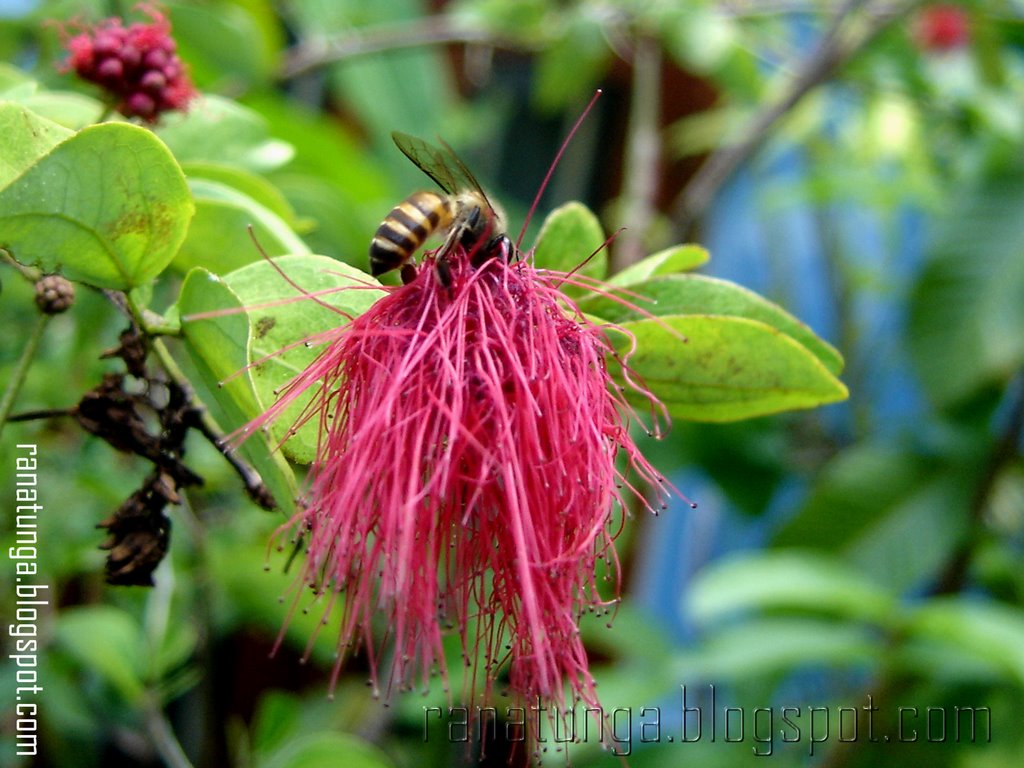
Today morning I saw these bees busy at work. Got some really beautiful photos of them.
I just thought of reading more on them & found some very interesting facts...
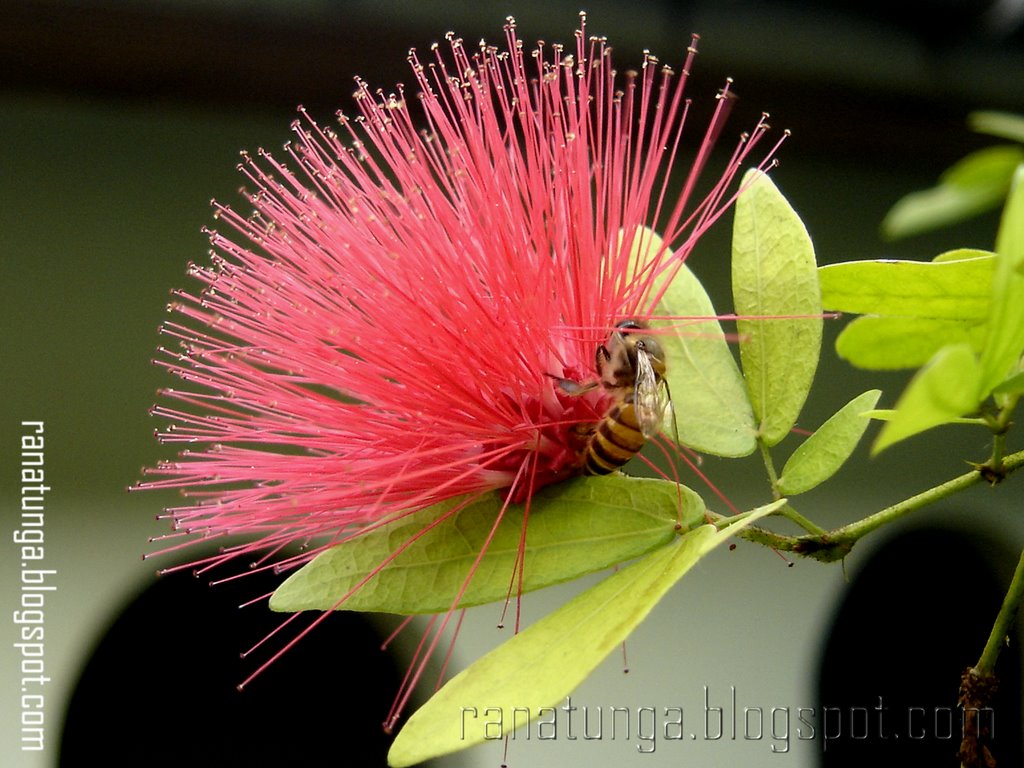 Busy at work | Bee Facts:
|
 | |
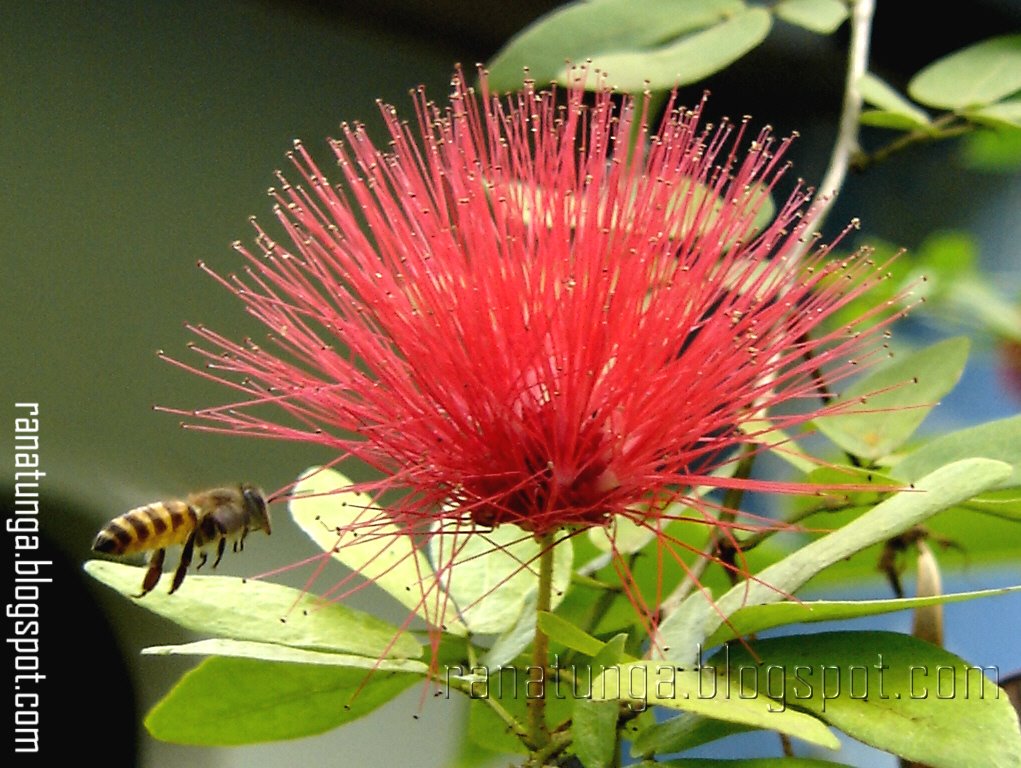 Hovering near a flower, just before landing on it... | |
 Bees still busy at work, even after the flowers had withered away in the hot sun | |
 |
2006-08-20
Kandyan Dancer Orchid
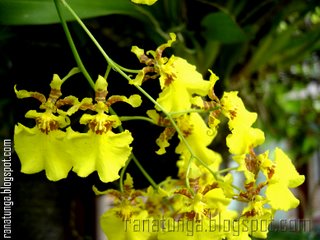
 These are Kandyan Dancer Orchids from our garden. This belongs to the genus Onicidium, which has more than 300 orchid species.
I could not find the exact species name of this orchid though.
These have been named after it's resemblance to Kandyan Dancers, a traditional form of upcountry dancing in Sri Lanka, where the dancers wear highly ornamented costumes.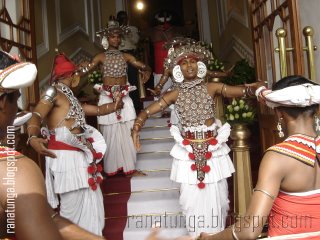 < Kandyan Dancers in the Procession on my Wedding day
Also visit Oncidium to read more on this genus of Orchids
2006-08-18
Birth time...
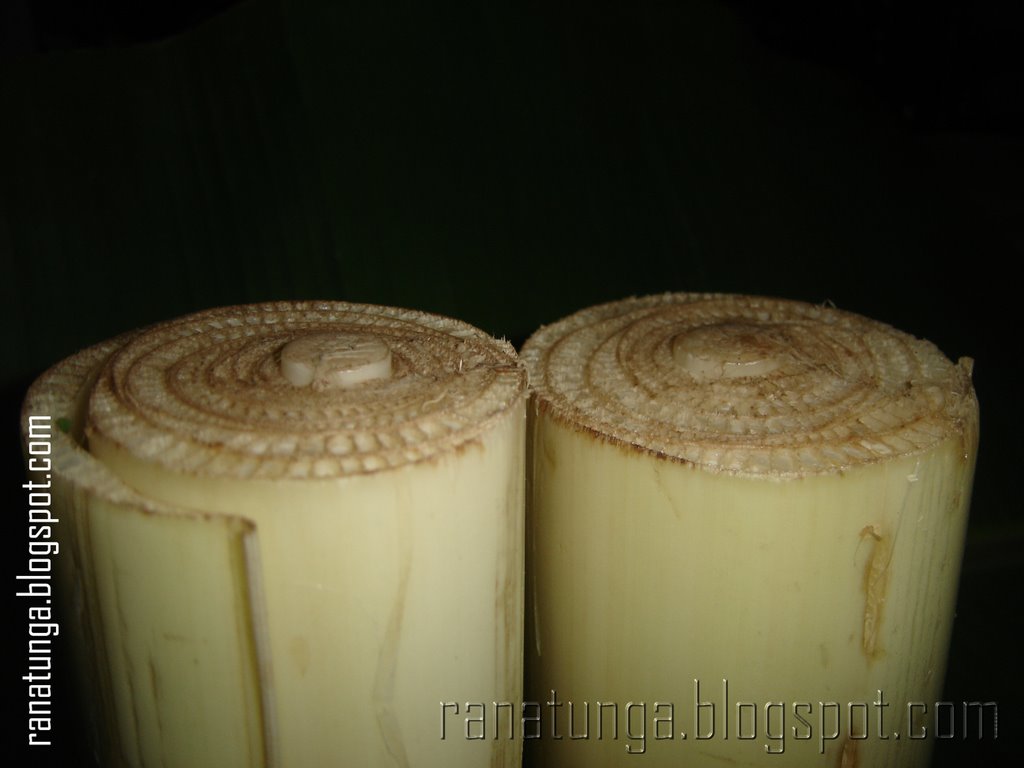 These are cut ends of two banana stems. As you can see, the middle part has grown a little bit. When I saw this, I remembered an ingenious method used by ancient Sri Lankans to calculate a new borns birth time (as most of the people did not have watches or clocks).
When a baby is about to be born, an elderly will go near a nearby banana tree. When he hears the first cry of the baby, he will cut the banana tree with a knife in one stroke. Then they will summon the village astrologer.
The astrologer will visit the place. He will measure the growth of the inner part of the cut end. Using this he will calculate the interval since baby was born & his arrival, thus calculating birth time of the baby.
Another difference can be seen in this ancient practice. Rather than taking the time when the child is delivered, they had considered the time at which the baby had taken the first breath as the birth time. But most of the time there is only a few seconds difference between these two.
The astrologer will visit the place. He will measure the growth of the inner part of the cut end. Using this he will calculate the interval since baby was born & his arrival, thus calculating birth time of the baby.
Another difference can be seen in this ancient practice. Rather than taking the time when the child is delivered, they had considered the time at which the baby had taken the first breath as the birth time. But most of the time there is only a few seconds difference between these two.
2006-08-09

2006-05-19
Lethal Prayer - let this prayer be ignored...
When I returned to room after having dinner, I found an interesting creature in my room. It's a Praying Mantis, also called Praying Mantid, so called due to its positioning of fore limbs. Mantis means Prophet in Greek. But do not get misled by it's humble appearance. Its a carnivore.
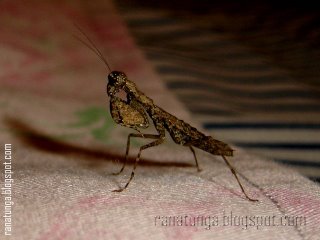
It feeds on other mantises, Insects such as butterflies, beetles, grasshoppers, flies & crickets. At the bottom of this post there is a link where you can see pictures of a mantis that has caught a hummingbird. It uses it's fore limbs equipped with razor sharp spines to deliver a fatal blow that will penetrate it's prey & it quickly bites the neck of the prey before starting to eat.
The one I saw was brownish in colour & they vary from Green to Pink & flower mantises are magnificently beautiful with flower like appearance. This is essential to it for it's survival as there are so many predators such as Birds & spiders that feed on them. Also Mantises use their camouflage to catch their prey, as unwary victims pass-by without noticing it.

It feeds on other mantises, Insects such as butterflies, beetles, grasshoppers, flies & crickets. At the bottom of this post there is a link where you can see pictures of a mantis that has caught a hummingbird. It uses it's fore limbs equipped with razor sharp spines to deliver a fatal blow that will penetrate it's prey & it quickly bites the neck of the prey before starting to eat.
The one I saw was brownish in colour & they vary from Green to Pink & flower mantises are magnificently beautiful with flower like appearance. This is essential to it for it's survival as there are so many predators such as Birds & spiders that feed on them. Also Mantises use their camouflage to catch their prey, as unwary victims pass-by without noticing it.
The size ranges from 0.5 cm to 30cm in size. 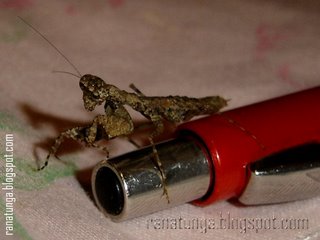 The specimen I found was a very small one, where I have taken a picture of it with a pen for size comparison.
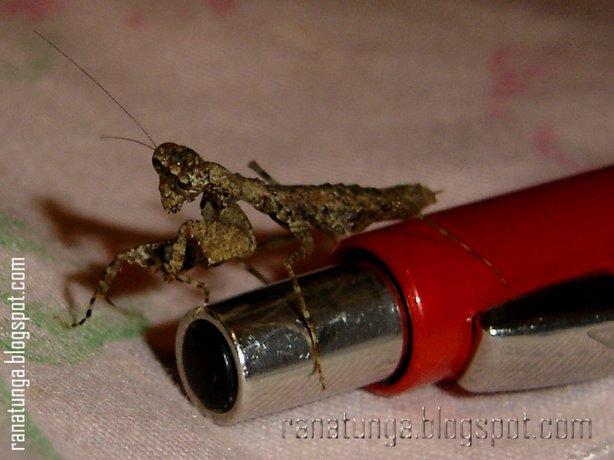 The specimen I found was a very small one, where I have taken a picture of it with a pen for size comparison.
 The mantises are helpful in keeping the pest populations at control, but they eat friendly insects too without any discrimination.
Read more about Praying matises,
2006-02-14
The culprit
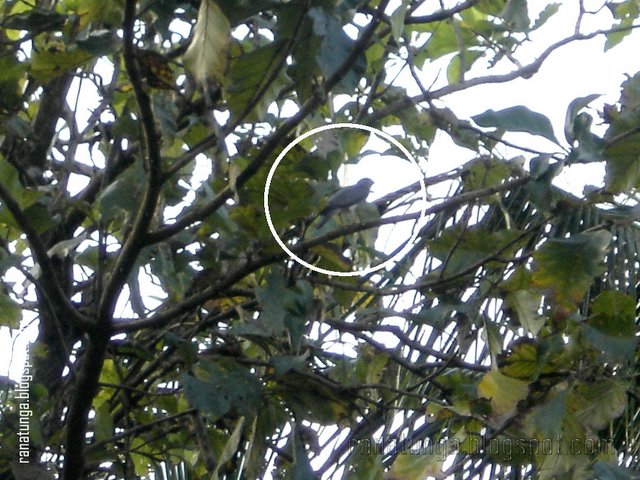

After the Bulbul family left the nest, I removed the tar sheets covering the nest. I thought the predator bird would return (see Tragedy...) if it saw the nest & I didn't had to wait long to get results. It came right to the nest & was searching all over.
It was a magnificent bird with grey-blue coloured body & was very fast. I only managed to capture it's photo after it flew away to a distant tree.
This was a Shikra ('kurulugoya' in sinhala). A magnificently beautiful bird.
The scientific name is Accipiter badius.
It's a bird of prey. It's a small bird with short broad wings & long tail. It's found in South Asia & sub-Saharan Africa. It's prey include lizards, dragonflies, small birds & mammals.
Further readings:
Also see my other post on Bulbul nest:
Images posted with 
2006-02-12
Flying lessons
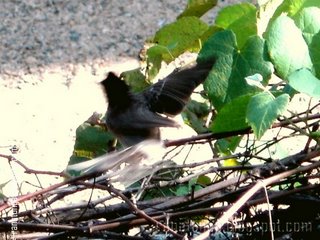
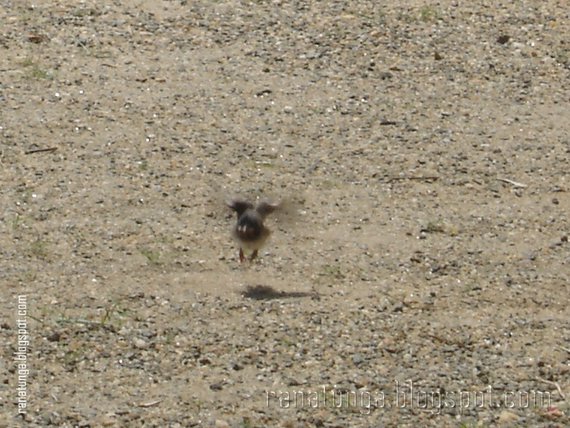
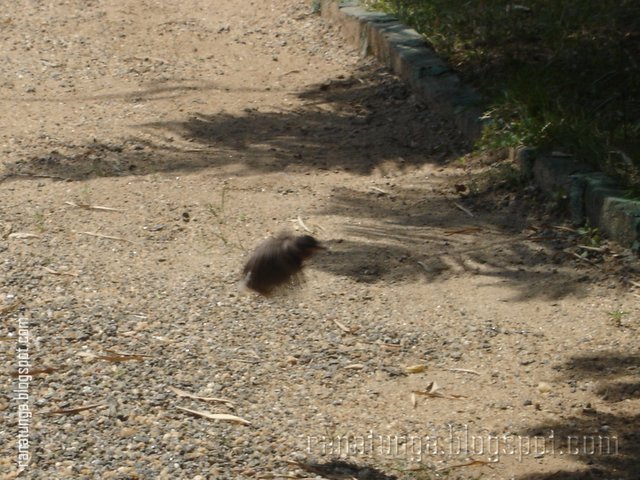
Bulbul parent showing how to fly
Today was a special day & especially to the bulbul birdling. I could witness the first flight of the birdling.
The bulbul parents were bringing food near & would take it away compelling the birdling to come out of the nest & it jumped out of the nest readily. I always stayed around, as I did not wanted it to end in our cats stomach. It seems they didn't mind me sitting around. Even I examined the birdling for injuries few times when it fell from above during the process.
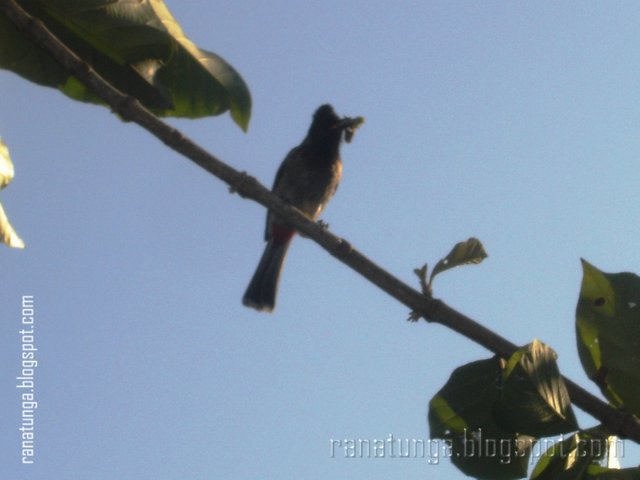
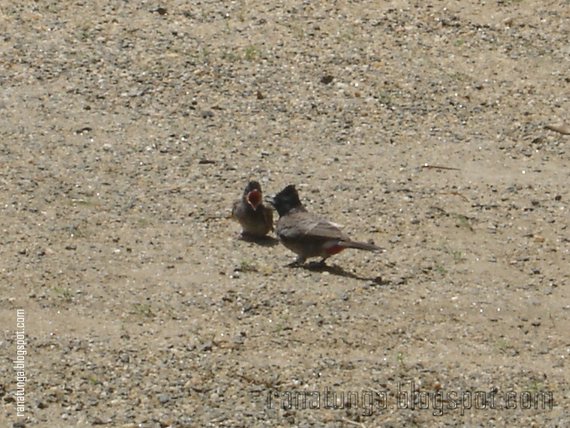
It was a nice thing to see. The parents brought food near it & flew away as birdling approached. Parents flapped wings to show the young one how to fly. Soon the small one started flapping wings & off it went few yards. I was amazed to see it & was very happy too. After few more flights, three of them flew away to distant.
Then only I felt sad, as I missed them...
The bulbul parents were bringing food near & would take it away compelling the birdling to come out of the nest & it jumped out of the nest readily. I always stayed around, as I did not wanted it to end in our cats stomach. It seems they didn't mind me sitting around. Even I examined the birdling for injuries few times when it fell from above during the process.
It was a nice thing to see. The parents brought food near it & flew away as birdling approached. Parents flapped wings to show the young one how to fly. Soon the small one started flapping wings & off it went few yards. I was amazed to see it & was very happy too. After few more flights, three of them flew away to distant.
Then only I felt sad, as I missed them...
It seems this brings an end to the 'Tale of the Bulbul family'
To read from the bigining please read,
To read from the bigining please read,

Parents bringing food near the birdling to force it out of th nest. 
Birdling on the ground, after it jumped out of the nest

Rewards for getting out of the nest
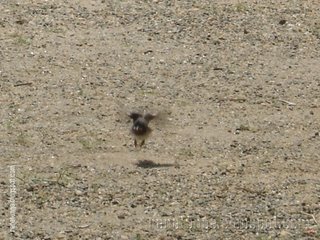
Here we go...

Quick... can anybody tell me how to land???
Images published with

2006-02-10
Tragedy...
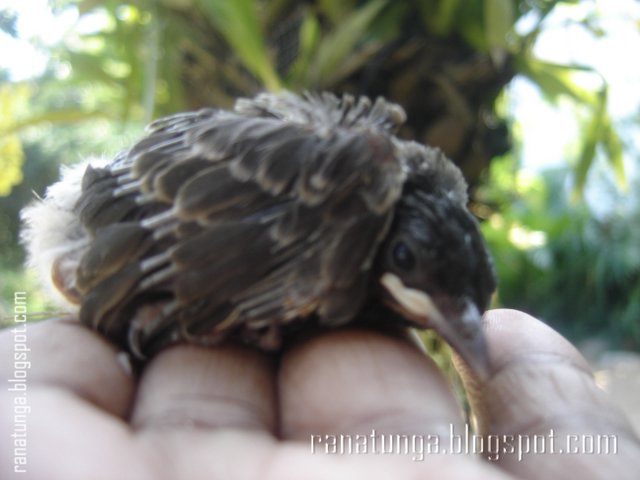
The fallen Bulbul birdling. The only survivor...
I was watching a cricket match when I heard the screams of the Bulbuls. I thought it was a cat who had attacked their nest & I went quickly to see whats happening. I saw a large bird fly away & it dropped something & it was one from the nest. I was there in time to save only one bulbul birdling.I returned it to the nest.
Other two birdlings were not to be seen. May be the predator bird had had them. I could not see the predator bird as it flew away. But it is sure to return. So I placed two tar-sheets over the nest & Bulbul parent could get into the nest from the side.
The Bulbul parents were watching from a distance. They did not return to the nest even at that nite. But next day morning it flew away as I came near the nest. During past few weeks the bulbul parents were so acoustemed to us, we could go near them without alarming them. But now because of this incidence they even seem to suspect us.
 |
Birdling alone in nest (seen from below) |
 |
| The only survived birdling in the nest, alone at night |
 |
| Tar coat on top of the nest. Bulbul parent also seen coming out of the nest |
2006-02-04
Red vented Bulbul
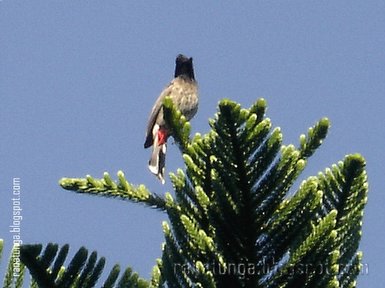
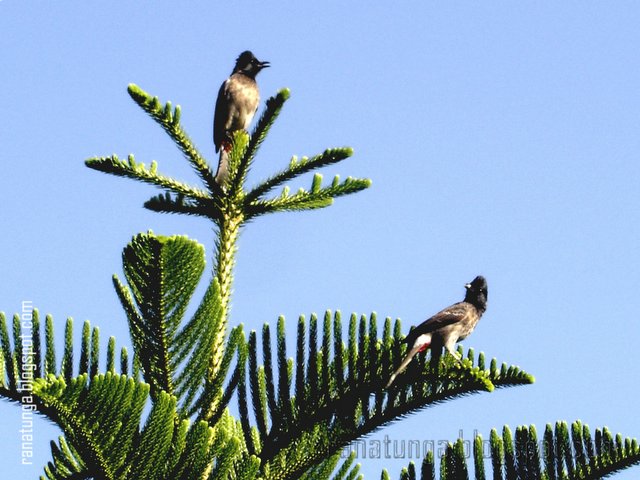 | The scientific name is Pycnonotus cafer. It gets its name from the reddish area found at the vent. This can be seen very clearly in the lower photograph. Generally it is dark in colour with white breast & rump. It has a crest & called in Sri Lanka as 'Kondaya' meaning 'haired' because of it. They consume fruits (eg: plantain & papaya), insects, flower nectar, seeds & buds. They build a cup shaped nest where they lay 2 to 3 eggs. This is native to parts of Asia ranging from Pakistan, India & Sri Lanka to southwest China & also some pacific islands where it was introduced later. It had been nominated to be among '100 of worlds worst invaders'. Further readings: also see my other post on Bulbul nest: |
 | |
Subscribe to:
Posts (Atom)


 Posts
Posts


