Showing posts with label Facts. Show all posts

2007-09-27

Happy 9th Birthday Google!

It's Google's 9th Birthday today. Happy Birthday Google!
I was very much moved by a comment left by a visitor to my blog post
Happy Birthday Google!, exactly one year ago..

prakashraju said...
YOU ARE MY GOD ALMIGHTY!!!!
EVERYTHING IS IN YOU!!!!

I LOVE YOU GOOGLE!!
WITHOUT YOU MY DAYS WON'T START!!
I WISH YOU MANY MANY HAPPY RETURNS OF THE DAY!!!

I PRAY FOR YOUR SUCCESS!!!!
WITH LOVE & AFFECTION!

yours forever!!!!

I couldn't agree more.

Well this time I thought of bringing some facts about the Web search, the thing that Google does best...
  • Choose your search term wisely. Multiple terms will narrow down your search.
  • The order in which search terms are entered will effect the results.
  • All letters are treated as lowercase even if you type in uppercase letters.
  • and >> No need to have 'and' between words. By default all search terms entered are searched for.
  • + >> common words & single digits & characters are ignored in Google searches. To include them, you need to have + sign in front it.
  • " " >> having quotes around search terms will search for exact phrase.
  • - >> to exclude a term from the search, add a - sign in front of the term
  • ~ >> to include synonyms in a search
    • Eg: ~food research includes results with Food, Nutrition, Restaurant , etc.. as synonyms of food
  • OR >> to include either of the terms, put uppercase 'OR' between two search terms.
  • .. >> to include a number range, which can be years, $, v, kg etc.. as you specify.
  • * >> to include one or more keywords in it's place. Google will fill in the blanks.
  • site: >> to restrict a search to a particular web site.
  • allintitle: >> to restrict for search terms appearing only in the title of web pages.
  • intitle: >> to find web pages with the search term appearing immediately after 'intitle:' in the title of a web page. Note: No space between 'intitle:' & search term.
  • allinurl: >> to find web pages with all of the search terms occurring in their URL.
  • inurl: >> to find web pages with the term immediately after 'inurl:' occurring in the url. Note: No space between 'inurl:' & search term.
  • link: >> to find web pages that link to a particular site.
  • related: >> to find similar web pages to a specified web page.
  • cache: >> to get last snapshot Google bot created
  • info: >> to get information Google has collected about a web page.
  • definition: >> to get a definition of a word, as given in various web sites
  • filetype: or ext: >> to retrict search to a file type other than html. Supported types are,
    • Adobe Portable Document Format (pdf)
    • Adobe PostScript (ps)
    • Lotus 1-2-3 (wk1, wk2, wk3, wk4, wk5, wki, wks, wku)
    • Lotus WordPro (lwp)
    • MacWrite (mw)
    • Microsoft Excel (xls)
    • Microsoft PowerPoint (ppt)
    • Microsoft Word (doc)
    • Microsoft Works (wks, wps, wdb)
    • Microsoft Write (wri)
    • Rich Text Format (rtf)
    • Shockwave Flash (swf)
    • Text (ans, txt)
Further readings at Google: Web Search Help Center :

2007-08-17

Ministry of Education Hacked into...

Well not exactly...
I was browsing among the Government Web sites, when I came across our Ministry of Education web site (see the image on right). I was shocked to see that it had been Hacked by some hackers. I quickly checked the Google cache for the snapshot they had created (see the image on left side). It was dated 15 Aug 2007, 14:18:06 GMT. So this site had been hacked during last 3 days. The hackers intentions are not very clear from what they had done. May be they just wanted to deface a government web site for fun.
It seems only the home page of the site had been hacked.
On further research I came across Zone-H which has an archive of Web sites that have been hacked. I was amazed to see the number of Sri Lankan Government web sites that had been subjected to defacement by various Hacking groups.
As I could not link to the particular table, I have copied the text, as you can see below:

DateAttackerDomainOSView
2007/07/30 RitualistaS mcg.mpi.gov.lk Win 2003 View Mirror
2007/01/27 Dr.Jr7 dmc.gov.lk/external.asp Win 2003 View Mirror
2007/01/06 yas mail.samurdhi.gov.lk Linux View Mirror
2006/12/04 DeltahackingSecurityTEAM primeminister.gov.lk/record/delta.htm Linux View Mirror
2005/12/12 Devil Code mpdinor.gov.lk Win 2000 View Mirror
2005/10/16 Tz4r muslimaffairs.gov.lk/forum Linux View Mirror
2005/03/14 batistuta muslimaffairs.gov.lk/forum Linux View Mirror
2005/02/06 H4ck3rsBR slelections.gov.lk SolarisSunOS View Mirror
2005/02/06 H4ck3rsBR sec.gov.lk SolarisSunOS View Mirror
2005/02/06 H4ck3rsBR ports-aviation.gov.lk SolarisSunOS View Mirror
2005/02/06 H4ck3rsBR npd.gov.lk SolarisSunOS View Mirror
2005/02/06 H4ck3rsBR trc.gov.lk SolarisSunOS View Mirror
2004/01/24 Red Eye ibsl.gov.lk Win 2000 View Mirror
2003/06/19 [ LunixO ] moe.gov.lk Linux View Mirror
2003/06/07 Digital lords moe.gov.lk Linux View Mirror
2002/09/27 PaGgY hinduministry.lk Win 2000 View Mirror
2001/04/08 SadoR erd.gov.lk Windows View Mirror
2001/04/04 Silver Lords customs.gov.lk Windows View Mirror
2001/04/01 Silver Lords erd.gov.lk Windows View Mirror
2001/04/01 PoizonB0x customs.gov.lk Windows View Mirror
2001/03/31 PoizonB0x erd.gov.lk Windows View Mirror
2001/03/18 LOUCOS.BR erd.gov.lk Windows View Mirror
2001/02/26 Alien00 erd.gov.lk Windows View Mirror
2000/12/24 Silver Lords erd.gov.lk Windows View Mirror
2000/12/23 Silver Lords customs.gov.lk Windows View Mirror
2000/06/04 EhW erd.gov.lk Windows View Mirror

Still most of the above sites are not back online or have not been repaired completely. Any way most of our government websites are ill designed & not maintained well. Almost all of them use tables rather than CSS for layouts & are very poor in design, compromising their usability.

2007-07-18

Earthquake near Sri Lanka!!!


Earth tremors have been felt in some areas of Sri Lanka, including Colombo & Kandy. The images here are from USGS Earthquake Hazards Program.

According to USGS,
Magnitude: 5.2
Time: at 04:27:28 (UTC)
at 10:27:28 am local time at epicenter
at 09:57:28 am Colombo, Sri Lanka
Location: 6.548°N, 84.455°E (In bay of Bengal)
Distance: 510 km (315 miles) E of Colombo, Sri Lanka
More details visit here Magnitude 5.2 - BAY OF BENGAL

I couldn't find any details regarding any Tsunami Warnings at the time of posting.
The relevant links are:

2007-05-31

Once in a Blue Moon


Once in a Blue Moon
Originally uploaded by Kalamakia
Well it seems my postings have become so rare lately, that I post 'Once In a Blue Moon'. Well today is a such day, that we are going to have a Blue Moon.
Blue Moon, has nothing to do with it's colour. It only means, a full moon that occurs for the second time in a month. Considering that the average interval between two full moons is about 29.5 days & a month has about 30.5 days, it's a rare occurrence to have two full moons in a month. But it occurs about 41 times in a century or only occurs once in about 32 months.
The term 'Once in a Blue Moon' has been in use in medieval England from old times & one such occasion was in a 'Treatyse of the Buryall of the Masse' by William Barlow, the Bishop of Chichester, in 1528.
But the usage of this phrase had had different meanings during these long years of use,
  • in 16th century: obvious absurdities, where there could be no doubt.
  • in 18th century: as equal to 'never'
  • in mid 19th century: a fairly infrequent event
There had been times, where the moon really appeared to be blue. This occurs due to light reflected from moon being scattered by dust particles which are about a micron or so in diameter. In these occasions dust particles were ejected to upper atmosphere during large volcano eruptions such as that occurred in 1883 of Krakatoa volcano or large forest fires that occurred in 1953 in western Canada.
But this year Americans have seemed to have celebrated the Blue Moon on 31st of May, 2007. >>> Blue Moon over North America on Thursday. How can that be? How can they have a Blue Moon two month before New Zelander's had one?
Well it also has a logical explanation. This occurs due to the World Time Zones. When the time of the full moon changes with each time zone it falls to the next month. This is illustrated below.
Time Zone City Full Moon 1 Full Moon 2 Full Moon 3 Full Moon 4
GMT + 12hrs Auckland 2 May @ 22:09 1 June @ 13:04 1 July @ 01:49 30 July @ 12:48
GMT + 04hrs Moscow 2 May @ 14:09 1 June @ 05:04 30 June @ 17:49 30 July @ 04:48
GMT Greenwich 2 May @ 10:09 1 June @ 01:04 30 June @ 13:49 30 July @ 00:48
GMT - 05hrs Chicago 2 May @ 05:09 31 May @ 20:04 30 June @ 08:49 29 July @ 19:48

For more details go to The Blue Moon of 2007.

It seems the method used for calculating the blue moon astronomically also had not been the one used earlier. This new definition had come into use after it had been mistakenly interpreted by an amateur astronomer in an article in 1946 in Sky & Telescope magazine on Blue Moons (see What's a Blue Moon?). It had then been adopted by various other newspapers, radio & TV shows giving wide publicity to this misinterpretation.
The correct definition had been a complex one, that uses seasons rather than months to calculate the blue moon. The third full moon occurring in a season with 4 full moons had been considered to be the blue moon (Usually a season only had three full moons). But it had not been so simple either.
The year they used was 'tropical year' running from one winter solstice to the next. The seasons were defined using a method which gives seasons of equal duration (which uses dynamical mean Sun or fictitious mean Sun, which are imaginary bodies & this method is not used now to define seasons). Then also they used some rules which are laid down in Gregorian calendar reform in 1582.
To see a list of blue moons according to this old definition visit Blue Moon - four Full Moons in a season. According to this it seems there is no Blue Moon in 2007. Phew... after all I'm not doing blog posts Once in a Blue Moon.

references:

2007-03-28

Woodpecker's headache!

These are a couple of Red backed Woodpeckers or Black-Rumped Flamebacks (Dinopium benghalense) I saw in my backyard. I got their attention because of the characteristic hammering sound they generate while searching for insects in tree barks.
When I did a web search, I found some amazing evolutionary adaptations they have for their niche.
They hammer 10 times a second up to 5 hours & creates a force of 30G (30 times the force of gravity) when the beak hits the tree bark.


  • beak is stronger than steel with a chisel like tip
  • neck muscles highly developed for hammering
  • skull is relatively thick with relatively spongy bone to cushion the brain
  • bones between skull & beak are joined by flexible cartilage, which cushions the shock
  • relatively less cerebrospinal fluid around brain & relatively small brain, less prone to concussion
  • contracts mandibular muscles just before impact, transmitting the shock to whole body passing the brain
Read more,

2007-02-04

Are you over weight? Check it for yourself...

Are you over weight?
Are you putting up more fat?
Is your new year's resolution is to loose some weight?
Wondering how much weight you should loose?

For this purpose, Body Mass Index (BMI) is used. It checks whether an individual has appropriate weight for height.
The formula is; BMI = Weight in kg/ Height in meteres2

I have done the hard part & wrote the below JavaScript calculator to do it. Before proceeding any further, shall we do some calculations? Use the below BMI calculator to calculate your BMI.


BMI value is independent of age & sex. So all age groups & both males & females can use it to assess their health risks & it indicates body fatness. Health risks increase at both ends of the spectrum, especially at higher end. The WHO classification is used in this calculator. There is an ongoing debate, whether to have different cut-off points for different ethnic groups, specially Asians, but still the results are inconclusive.
BMI itself is not a diagnostic tool. If your BMI is higher than 24.99, you have a higher tendency to have health risks associated with obesity. So in that case a doctor needs to check up whether you really have any health risks & to check whether you should lose weight.

Read further on BMI:
Wikipedia: Body mass index
CDC: About BMI for Adults

Read further on, Controlling Your Weight


Notice:
Above BMI calculator was written by me. I'm not a pro in Javascript. If you find any bugs, please fell free to bring it to my notice. This have been tweaked to run on Firefox 2. It had been tested on IE 6. both on MS Windows. If you find any problems in using it on any other browser or platform, please put a comment with the problem you have noticed, and a method to contact you, to get further details if I need to. Thank you.

2006-10-02

Busy Bees...

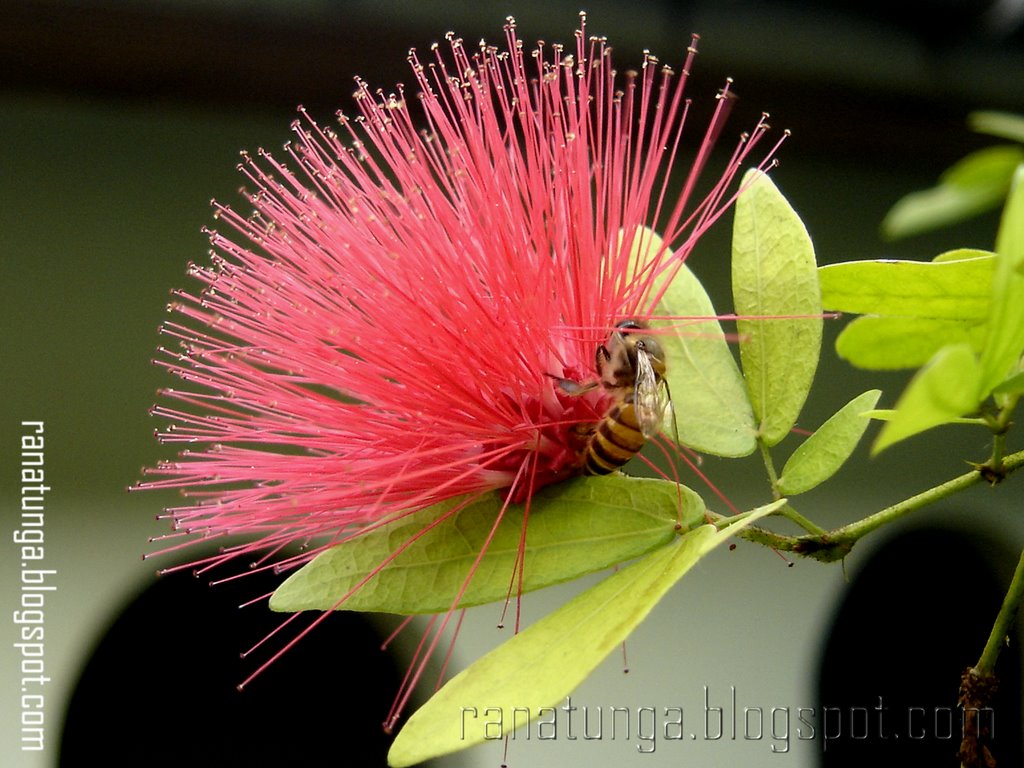
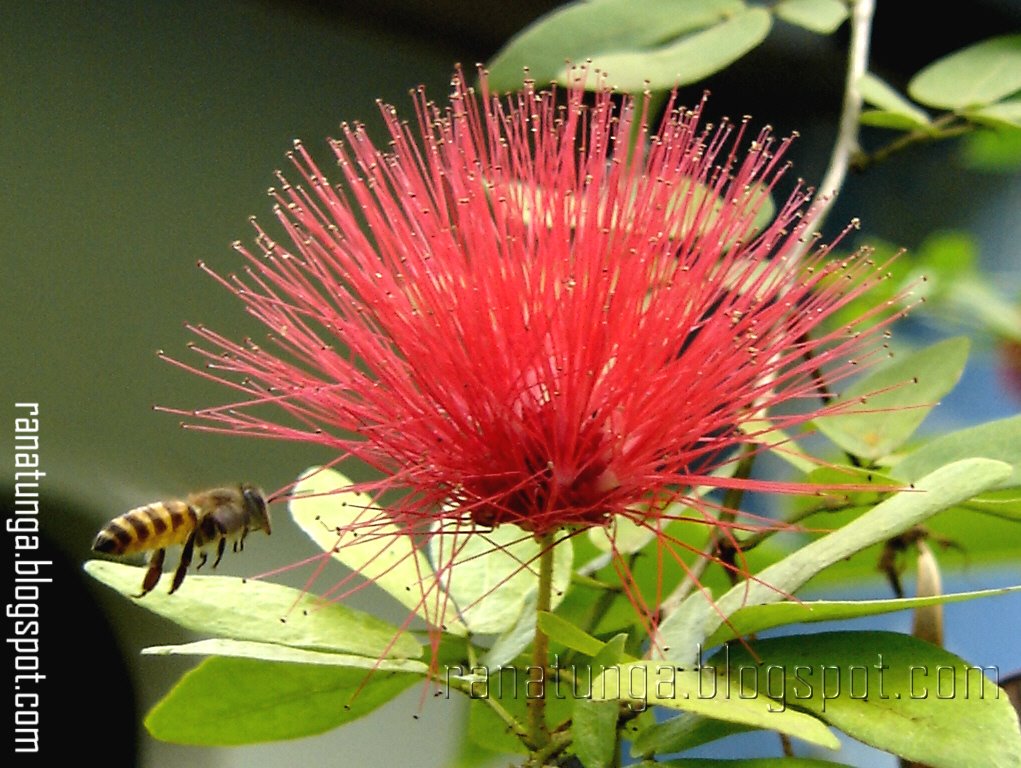
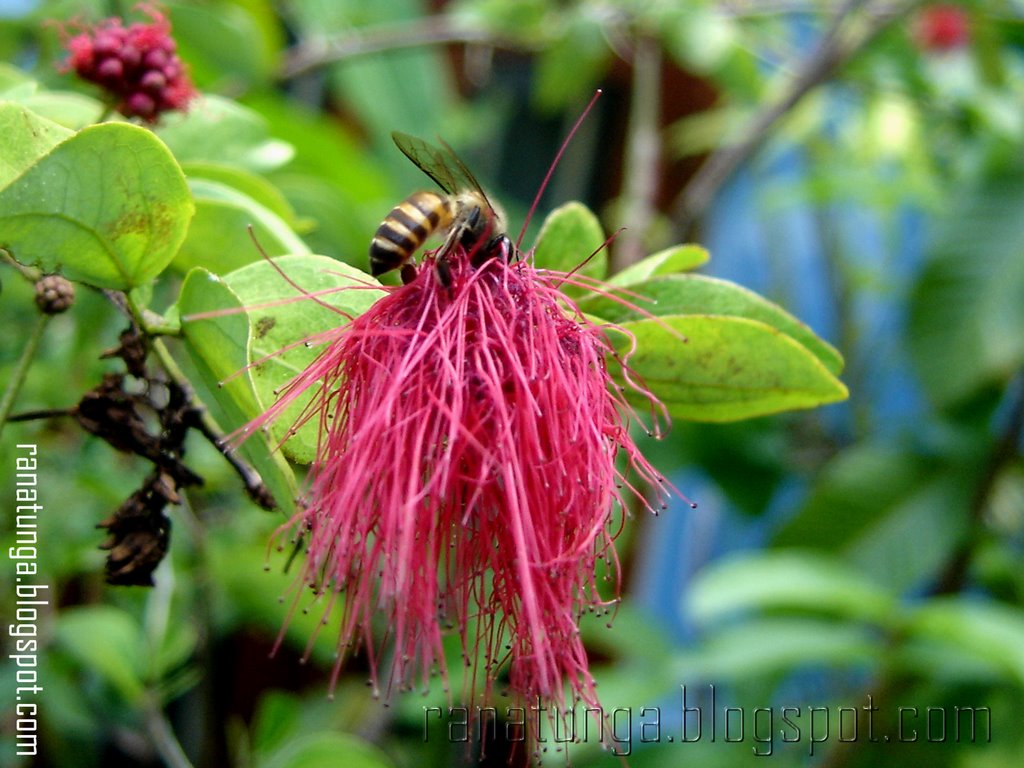
Today morning I saw these bees busy at work. Got some really beautiful photos of them.
I just thought of reading more on them & found some very interesting facts...


Busy at work

Bee Facts:

  • Belong to genus Apis

  • Have been producing honey for at least 100 million years.

  • Have 4 wings, 5 eyes & fly at an average of 13-15 mph.

  • Stroke wings 13,800 beats/minute, thus making a distinctive buzz.

  • Produce beeswax from 8 paired glands on the underside of their abdomen.

  • Honey is created when bees mix plant nectar with their own enzymes & then evaporate it by fanning their wings.

  • Honey contains about 17.1% water, 38.5% Fructose, 31.0% Glucose & Maltose, Sucrose and other complex carbohydrates.

  • Honey supplies 2 stages of energy, Glucose is absorbed quickly & gives an immediate energy boost & Fructose is absorbed more slowly providing sustained energy.

  • Average hive temperature of 33ºC is maintained even if the outside temperature is 43ºC or -40ºC.

  • A colony contains one queen, 500 to 1,000 drones and about 30,000 to 60,000 workers.

  • Worker bees live for about 28 to 35 days

  • Bees have an unusual genetic sex determination system, haplodiploidy. Workers are produced from fertilized eggs and have a double set of chromosomes. The males, or drones, develop from unfertilized eggs and are thus haploid with only a single set of chromosomes.

  • Queen may mate with up to 17 drones over a 1-2 day period of mating flights & stores the sperm in her spermatheca, thus she has a lifetime supply and never mates again.

  • Queen bees live for 2 to 5 years.

  • Queens will lay almost 2000 eggs/day.

  • Queen bees mandibular gland produces a pheromone, called queen substance, which workers lick from the queen's body and pass along. It inhibits the ovaries of workers.

  • When the bee stings, the stinger, poison sac and several others parts are torn from the bee's body to be left on the victim & it will soon die.

  • Bees communicate using Dance language & consists of a dance in a circle, for indicating sources & a tail-wagging dance in which the exact distance is indicated by a number of straight runs with abdominal wagging, fewer the runs per minute, farther away the source.


Hovering near a flower, just before landing on it...

Bees still busy at work,
even after the flowers had withered
away in the hot sun

2006-02-14

The culprit


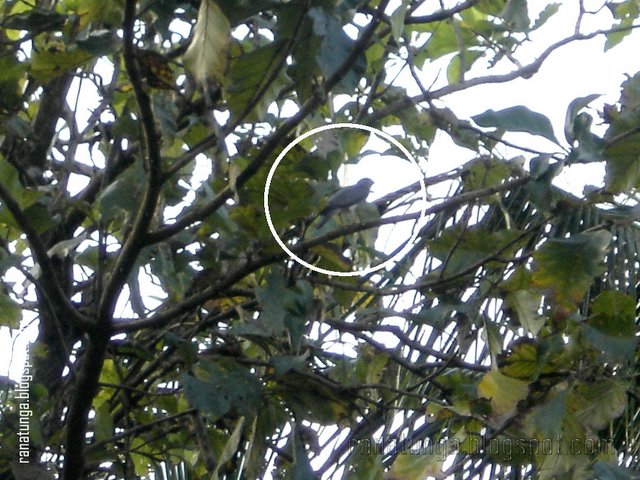
After the Bulbul family left the nest, I removed the tar sheets covering the nest. I thought the predator bird would return (see Tragedy...) if it saw the nest & I didn't had to wait long to get results. It came right to the nest & was searching all over.
It was a magnificent bird with grey-blue coloured body & was very fast. I only managed to capture it's photo after it flew away to a distant tree.

This was a Shikra ('kurulugoya' in sinhala). A magnificently beautiful bird.

The scientific name is Accipiter badius.

It's a bird of prey. It's a small bird with short broad wings & long tail. It's found in South Asia & sub-Saharan Africa. It's prey include lizards, dragonflies, small birds & mammals.


Further readings:

Also see my other post on Bulbul nest:

Images posted with Posted by Picasa

2006-02-04

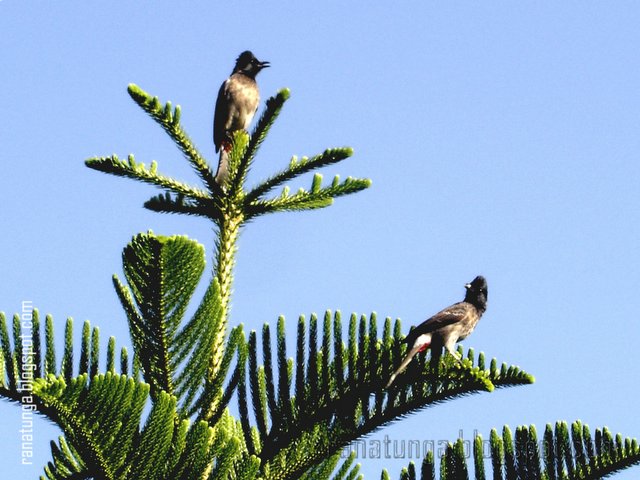
Red vented Bulbul

The scientific name is Pycnonotus cafer.

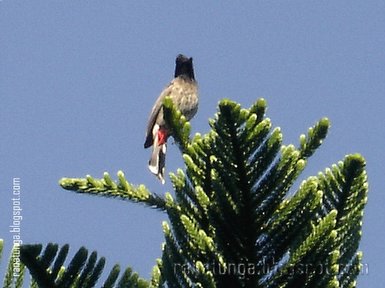
It gets its name from the reddish area found at the vent. This can be seen very clearly in the lower photograph. Generally it is dark in colour with white breast & rump. It has a crest & called in Sri Lanka as 'Kondaya' meaning 'haired' because of it.

They consume fruits (eg: plantain & papaya), insects, flower nectar, seeds & buds.

They build a cup shaped nest where they lay 2 to 3 eggs.

This is native to parts of Asia ranging from Pakistan, India & Sri Lanka to southwest China & also some pacific islands where it was introduced later. It had been nominated to be among '100 of worlds worst invaders'.

Further readings:

also see my other post on Bulbul nest:

New life...


2006-01-15

Glorious flower in the Garden

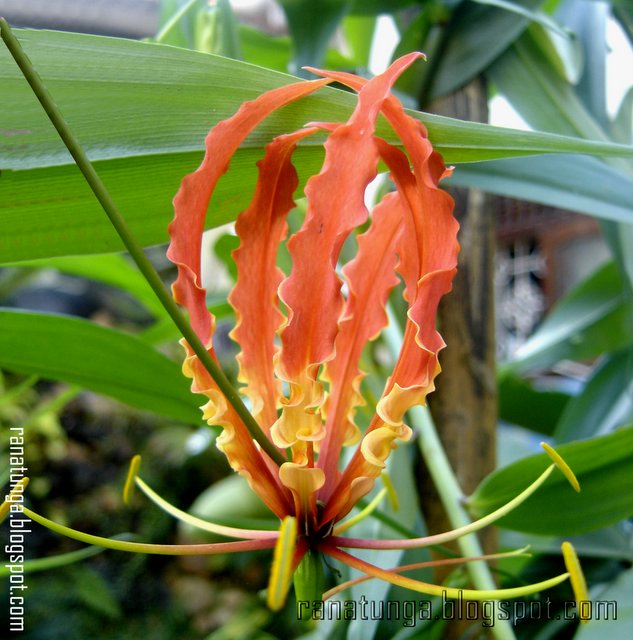
This is a bunch of Glori Lilies, also known as Flame Lily, Climbing lily & Gloriosa Lily, I found in our garden. This plant is a creeper & the tips of the leaves wrap around substrates. The scientific name is Gloriosa superba.
Even though the flowers are very beautiful, all parts of this flowering plant are toxic. The tubers are the most toxic part. The toxicity is mainly due to alkaloid Colchicine. The lethal dose varies from 6mg to 20mg.
The features of poisoning may develop 6hrs to 12hrs after ingestion. They include,
  • Abdominal pain,
  • Nausea & Vomiting
  • Diarrhoea
  • Bleeding manifestations (after 24hrs)
  • Confusion, Convulsions & Coma


Management of the poisoning,

  • Gastric Lavage,
  • Multiple doses of Activated Charcoal,
  • Correction of other complications such correcting dehydration & shock, correcting electrolyte imbalances
  • Assisted ventilation if necessary
  • Forced Diuresis within first 24hrs

(Reference: Ravindra Fernando (2002) Management of Poisoning, 2nd revised Ed. The National Poison Information Centre, NHSL, Colombo, pp 114-116.)


Some information on this plant can be found at,


A detailed description of the poison Colchicine can be found at IPCS INCHEM

Puah had published a nice poem on this flower. Please read it too >> L'chaim"!: Temptation


Posted by Picasa